
Hernando County Court Records After a Jail Arrest
After an arrest in Hernando County, a person is booked into the detention center. The booking record shows the arrest charges, bond, and holds. The court record is a separate thing. The State Attorney for the Fifth Judicial Circuit reviews the arrest, then decides whether to file charges. When charges are filed, a case opens with the Clerk of the Circuit Court, and that case is the court record. The final outcome lives there, not on the jail roster.
It helps to keep the two sides apart. The booking and custody side is covered on the jail inmate records page, and booking photos are covered on the jail roster mugshots page. This page follows the court record, meaning the charges a prosecutor filed and how the case moves after an arrest.
The Hernando County Clerk's criminal courts page is the front door for case search, fees, bond refunds, and seal or expunge guidance: Hernando County Clerk criminal courts.
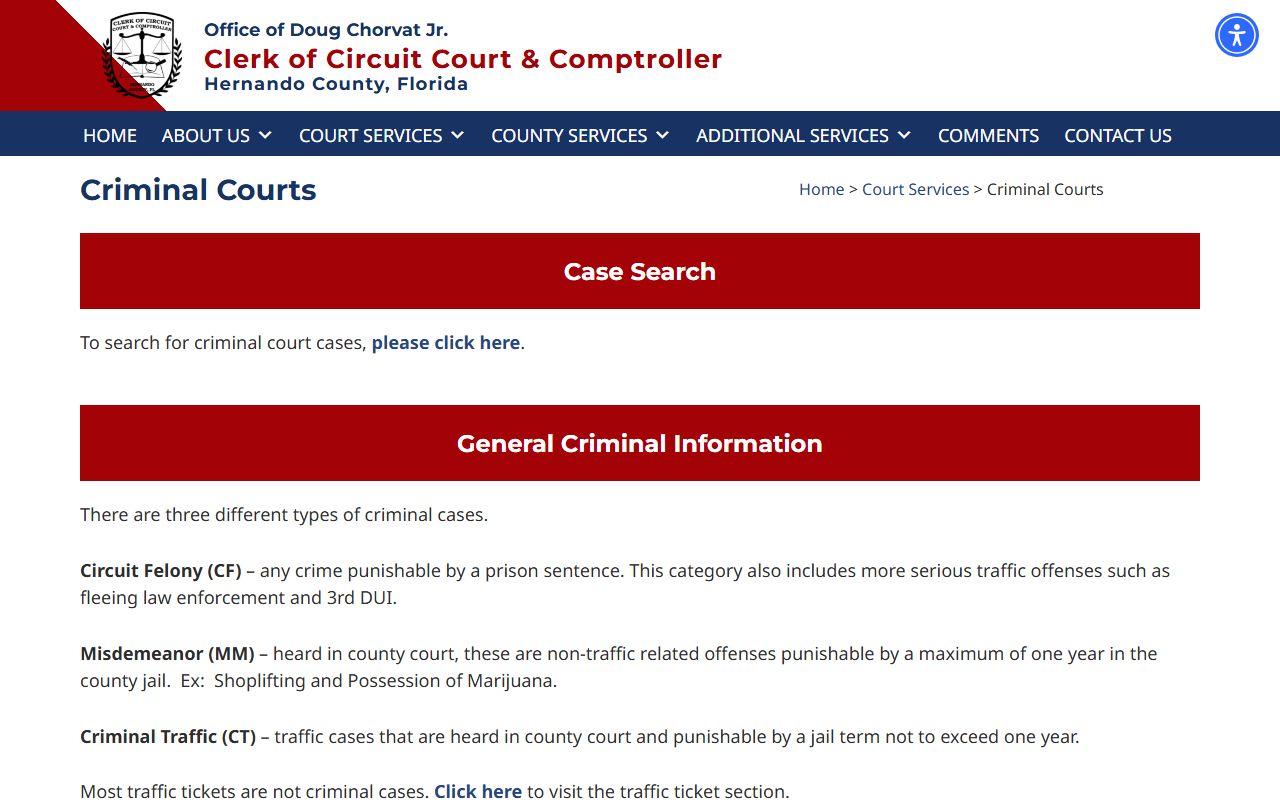
From there the case search links to the county's online court records system.
How to Find Hernando County Court Records After an Arrest
Court charges and case status appear in the county's online records system, Civitek OCRS, linked from the Clerk's criminal courts page. The arrest and booking detail stays on the jail roster, while the filed charges and the docket live in the court system. Start with the booking number and arrest details, then move to the court search.
- Open the Civitek OCRS access screen from the Clerk's criminal courts page.
- Choose Public access for anonymous searching, or sign in as an attorney, registered user, or party.
- Search by defendant name, and by case number if the jail profile showed one.
- Open the case and read the charge list, then check each charge's code, level, and current status.
The OCRS access screen offers four entry paths. Public access is anonymous, while the other three need a user ID and password. The downstream public search fields were not exposed in the static page during research, so the field set below covers the access options rather than every internal filter.
| Access Option | Type | Login Required | Notes |
|---|---|---|---|
| Public | Button | No | Anonymous access to court records. |
| Attorney | Button | Yes | Attorneys of record; user ID and password. |
| Registered User | Button | Yes | Registered access; user ID and password. |
| Party Access | Button | Yes | Party to a case; user ID and password. |
You can see the access screen and its four options here: Hernando County OCRS access.
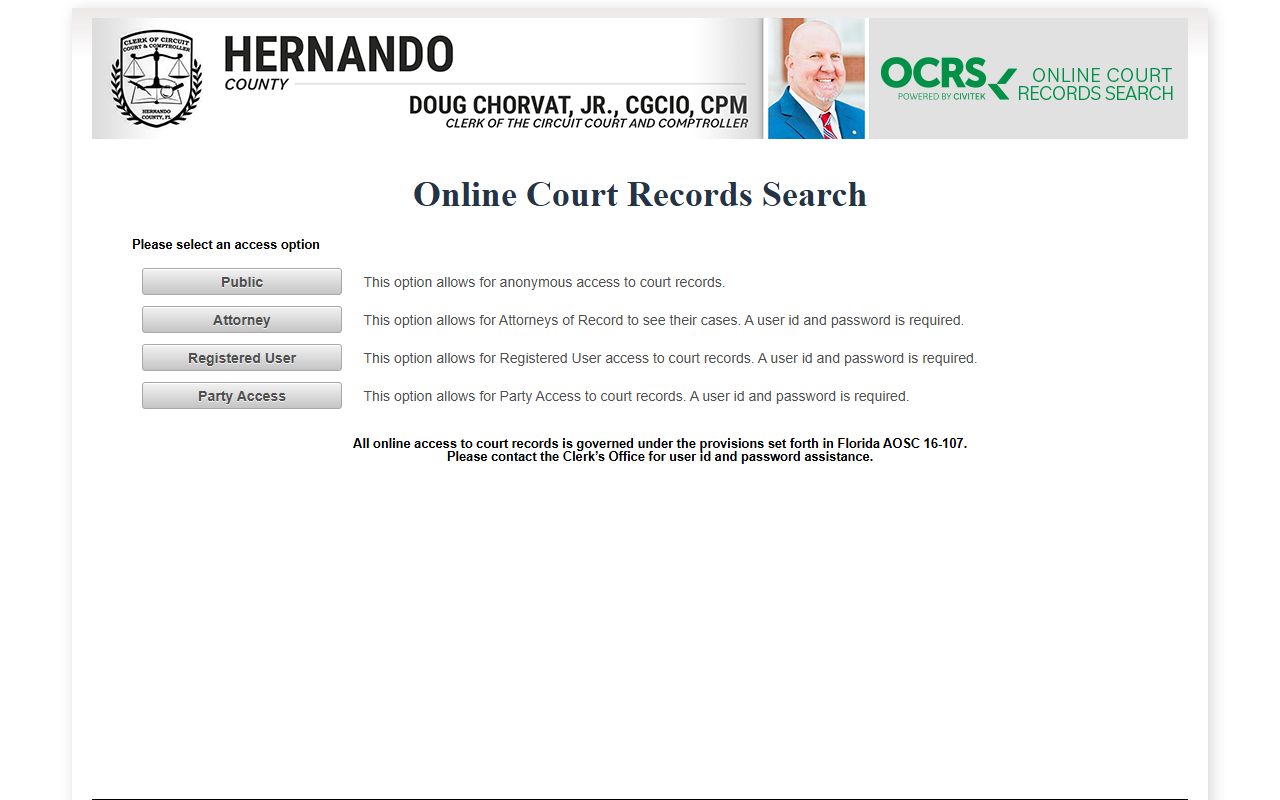
Online access is governed under Florida AOSC 16-107, which is why some images or documents are limited to certain user roles even when docket information is public. For a statewide criminal history rather than one county case, the FDLE process is the right channel.
How Charges Get Filed After an Arrest: Complaint, Information, and Indictment
Booking happens first, at the jail. The court charge record begins when the prosecutor files a charging document. There are three main types, and which one is used depends on the seriousness of the offense. In Florida, most felonies proceed by information filed by the State Attorney, while the most serious cases can go before a grand jury.
| Complaint | Information | Indictment | |
|---|---|---|---|
| Filed By | Officer or prosecutor | State Attorney | Grand jury |
| Common For | Misdemeanors | Many felonies | The most serious felonies |
| Starts | The case | The case | The case |
The Clerk sorts criminal cases into Circuit Felony, marked CF, for crimes punishable by prison, Misdemeanor, marked MM, for offenses with up to a year in county jail, and Criminal Traffic, marked CT, for traffic offenses heard in county court. Those codes help when searching the docket.
State Attorney Review and Formal Charges
Hernando County is served by the Office of the State Attorney, Fifth Judicial Circuit, which also covers Citrus, Lake, Marion, and Sumter Counties. The State Attorney is Bill Gladson. The office reviews law enforcement reports and the booking charges, then decides whether to prosecute. It can file the case by information, seek an indictment in qualifying matters, amend or reduce counts, or decline to file.
This review is why the court record can differ from the arrest record. A booking row may list one offense while the filed case lists another, fewer, or none. The State Attorney's office home page identifies its leadership and service area: Office of the State Attorney, Fifth Judicial Circuit.

The Clerk lists the State Attorney's office contact at (352) 754-4255 for case questions that belong with the prosecutor rather than the Clerk.
Charge Status and What It Means After an Arrest
Charges shift as a case moves. A count can be amended, reduced, added, or dropped. Booking charges on the jail roster can differ from what the prosecutor finally files. The status terms below show up in court records and explain where a case stands.
| Status | What It Means |
|---|---|
| Pending | The case or charge has not reached a final outcome. |
| Amended / Reduced | A charge was changed or lowered to a lesser offense. |
| Dismissed | The court or prosecutor ended the charge without a conviction. |
| Nolle Prosequi | The prosecutor chose not to go forward on the charge. |
Note: Clerk staff can give records and case-processing details but cannot give legal advice or explain why a person must attend court.
Bond and Release After an Arrest
Bond is first set from the Chief Judge bond schedule. At first appearance, also called an advisory hearing, a judge can keep the amount or change it. Some situations override the schedule. Domestic-related charges carry no bond until a judge sees the person, and a warrant arrest carries the bond set by the judge who signed the warrant. Holds and no-bond statuses can keep a person in custody even when another charge is bondable.
| Bond Type | How It Works |
|---|---|
| Cash Bond | Exact cash in the detention lobby, or online through GovPayNet for cash bail. |
| Surety Bond | Posted through a licensed bail agent; the sheriff cannot recommend one. |
| PR / Own Recognizance | Release on a promise to appear rather than a cash deposit. |
| No-Bond Hold | Release blocked until a judge acts or a hold clears. |
A DUI or BUI arrest carries a minimum eight-hour hold from the time of arrest before release, even after a bond is paid.
Warrants That Lead to an Arrest
Many bookings start with a warrant. The sheriff's office posts an active local warrant list, but it is delayed three days, and the office does not give warrant information by phone. To resolve a warrant, people are told to report to the jail or the Sheriff's Office in person. Warrant checks run on everyone entering and leaving the detention center, and a possible match from another county must be confirmed by that county before release.
For a wider search, the FDLE Public Access System lists statewide wanted persons, and the Clerk's OCRS docket can show warrants or a capias tied to a court case, such as a failure to appear. Court records after an arrest often connect back to one of these warrant sources.
Charges vs. Convictions
Being arrested and charged is not the same as being convicted. A charge is an accusation. A conviction is a verdict or a plea. Both can appear in public records, but they sit at different points in the case.
| Charge | Conviction | |
|---|---|---|
| Stage | Accusation | Verdict or plea |
| Burden of Proof | Probable cause | Beyond a reasonable doubt |
| Public Record | Yes | Yes |
Because a booking charge is only an accusation, the court docket or final disposition, not the jail roster, settles what actually happened in a case.
Sealed vs. Expunged Arrest Records
An arrest record can sometimes be cleared after a dismissal or an eligible outcome. Florida handles this through sealing and expunction, governed by statute, with FDLE issuing a certificate first and a court order required before relief. The Clerk explains that sealing hides court and police records from the public and most employers while law enforcement keeps access, and that expunction can cover fingerprints, booking photos, and identification records.
| Sealed | Expunged | |
|---|---|---|
| Visibility | Hidden from the public | Destroyed or returned, treated as never public |
| Law Enforcement | Limited access retained | Very limited access |
| Eligibility | Fla. Stat. 943.059; FDLE certificate and court order | Fla. Stat. 943.0585; FDLE certificate and court order |
FDLE says a certificate application comes first, relief does not happen until it receives a certified court order, and processing typically runs about 12 weeks. Mugshot removal after a cleared case connects to this same sealing and expunction process.
Cash Bond Refunds and Court Costs
Money tied to a case does not always come straight back. The Clerk says a cash-bond refund goes to the depositor once the case ends, and the depositor must keep a current address on file. Under Florida Statute 903.286, the Clerk withholds from a refund any fines or costs the defendant owes on any case. For a surety bond, questions go to the bond agent, not the Clerk.
There is also a cost-of-incarceration charge. The Clerk notes that under Florida Statute 960.293 a judge must order a defendant to reimburse the county $50 per day for each day sentenced to jail, collected through a civil restitution lien. That charge is based on sentenced days, not actual days served.
Important: This website is a private reference and is not a consumer reporting agency under the FCRA, so its court information cannot be used to screen for employment, housing, or credit.
Restricted Court Records After an Arrest in Hernando County
Not every court record after an arrest is open. Florida opens most records under Chapter 119, but exemptions apply. Sealed and expunged cases drop from public view. Certain active criminal investigative details stay closed while a case is live, even though basic arrest facts such as name, charge, and time of arrest remain public. Juvenile matters and some withheld dispositions carry added limits. When a public search comes up short, a records request to the Clerk or the sheriff can clarify what is available and what is restricted.